Showing posts with label Book Review. Show all posts

Wednesday, July 15, 2015

I Wish This Book Could Have Lasted Forever


What Comes Next and How to Like It
A Memoir by Abigail Thomas

I am a memoir expert.

I don't say this lightly. I read a lot. I think I've read more memoirs than anyone I know.

There was a period of my life lasting many years, when I struggled to live with what happened to me. I read only non-fiction. I read nothing fictional. A friend in the publishing industry finally got me started with the fiction again. You can read the story of that here.

Out of all of the non-fiction I read, a lot of it was memoirs. If it was a memoir, I probably read it. Some were good. Some were amazing. Some were very bad. Almost all of them were engrossing. That's what I needed at the time.

My reading has changed somewhat, but it's still slanted toward non-fiction. Even though I will read works of fiction, I still read a lot of memoirs.

Somehow in all of my single -minded memoir reading I missed the writing of Abigail Thomas. This is a mystery to me. I learned of her latest book on Facebook. I put it at the top of the To Read list I keep.

What Comes Next and How to Like It is a masterwork.  Not just of memoir. Of writing in general.

The good news for anyone reading this is that I've done a lot of reading. You can consider that legwork I have done on your behalf. There are a lot of books you can go ahead and skip. I strongly suggest you read this one.

I'm not going to tell you what the book is about. You can read about that anywhere. Abigail Thomas can tell her own story. It's not easy to classify anyway.

I will say that this book captures things that are true but difficult to write about. People and relationships and life are messy. It's all complicated. Things don't fit neatly into boxes. The space that lives between people can be ambiguous.

In the hands of a master this is illuminating and consuming. It's a cliché but I'll say it anyway. It was hard to put the book down. My husband and children were out one day and I'll always remember this snapshot of myself, eating the rare dinner alone and reading - consuming - this book. I was as happy as a person could be in those moments.

It made me happy but it wasn't easy. Like the Olympic skaters I love to watch, what seems simple on the outside is not. I felt like I was steeping in this book. Then after it was over it stuck with me.

There was this chatter going around for a while about a New York Times book review of What Comes Next and How to Like It. I purposely didn't read it until now. The review came out right before I read the book. I heard it was scathing.

Even with advance notice, I was not prepared to read what amounted to a literary version of a classic schoolyard bully incident. My review of this review is bad. I apologize in advance.

Katherine A. Powers has her head up her ass on this one.

Katherine A. Powers writes for The New York Times. I do not. Katherine A. Powers has won awards for her reviews. I have not. She gets paid for this. I do not.

But make no mistake. In spite of everything and all of these differences, let's not forget who the real memoir expert is here. That expert is me.


You might also enjoy:

Sunday, April 5, 2015

This Book Will Mess With Your Head


Still Alice by Lisa Genova

A few months ago, Jeremy was invited to join a book group. I'm glad that Jeremy enjoys book group. But it turns out that there's also something in it for me. That something is a steady infusion of new books. The book group selects a different book every month. Jeremy reads the book. If it strikes my fancy, I read it when he's finished.

Still Alice by Lisa Genova struck my fancy.

It was lying around the apartment. I read the description on the back cover. I kept asking Jeremy if he was finished yet. I bothered him about it. As soon as he was done reading that book I grabbed it.

The book is about a woman named Alice who develops early onset Alzheimer's disease. That's it in a nutshell.

If you've already seen the movie Still Alice, then you might want to skip this review, scroll to the bottom, and read some of the other book reviews I've written there. I haven't seen the movie yet, in spite of loving the book. I've been extremely busy. I'll see it at my first opportunity because I've heard it's excellent and I love the acting of Julianne Moore.

If you haven't seen the movie or read the book you can decide to read it or not based on my experience. I meant to write this post earlier, before the movie came out. Like I said earlier, I've been busy.

Lisa Genova knows her stuff. She's a neuroscientist. But she's also a gifted writer and a true storyteller. If you're anything like me, you will not be able to put the book down.

In my case, I found every excuse imaginable to read the book. On an extremely crowded rush hour subway, I had it suspended above my head, using the same hand I used to hold the pole to prop the book open. I read it while eating. I read it at night until I couldn't keep my eyes open. I used the book as a reward for completing unsavory tasks. All of the time I would have been on Facebook and Twitter I spent reading the book instead.

As a result of this binge reading behavior I finished the book about 24 hours after I started it. For me, the hook was that it was the combination of a great narrative with elements of a thriller, and a relatable main character that's fictional but so vividly drawn that she seems real.


I loved getting to know Alice. She's a brilliant Harvard Professor, a wife and mother. I found out what it is like to be smarter than I am.

I'm a big believer in multiple intelligences. When I say that Alice is smarter than me, I mean that in an IQ way. Pre-Alzheimer's she's extremely gifted at learning information quickly, imprinting it and accessing that information and learning immediately when needed.

Alice isn't smarter than me when it comes to emotional intelligence, social skills or creativity. She has some qualities that get her into hot water. It isn't the Alzheimer's. It's Alice. She's a fully formed character with foibles. If she were a real person and I were her friend, I'd have some things to say about her interpersonal skills.

I'm IQ smart. The difference between Alice and me is that I need what I call scaffolding. I have lists. I need more exposures to new information, in more than one modality. I need prompts to find the information. I have always been this way. The thing that makes me smarter than I used to be is anticipating what I need. Once I have these things, I'm golden.

I could tell from reading the book and reading between the lines of the book that Alice didn't need any of this before the onset of her disease.

One of the classic themes this story is mining is the idea of falling from a precipice. In this case, tumbling down from a tall ivory tower.

Here’s the part that messed with my head. At first I thought it was just me. I'm empathic, and apparently this feeling extends to people in books.

Then Jeremy told me that it messed with a lot of people's heads at book group.

Alice is realistic. She's my age. The forgetting she does at the beginning of the book is reminiscent of things that have happened to everyone. Then, slowly, and then more quickly things take a turn.

Because things are subtle at first I became hyper aware of any forgetfulness, inattention, stupid thoughts, misplaced items and my lifelong poor sense of direction. Things that usually pass by unnoticed were front and center for a few days.

This was really uncomfortable.

What saved this book from being just a sad sack and sorry tale was its complexity. Obviously, what is happening to Alice and a lot of real people is tragic. I've read articles and memoirs by caregivers in the Alzheimer's community. But I've never read anything where I got such a clear sense of what It could be like to have this disease from the inside. The person with the disease.

Most things get worse. But a few things get better. It allows you to think about what makes you you. Intelligence is a lot. For some people it can seem like almost everything. But memory isn't everything. Being independent isn't everything.

Things happen in this book that are amazingly touching and accommodating. It stretches the idea of what people can accommodate within themselves. It stretches the idea of what other people can accommodate.

Even if it's painful, even as it made me feel paranoid for a few days, even as I was sad for Alice and her family, for me, learning more about other people and their experience always trumps all of this. There is a richness and a humanity to this story that keeps me engaged. Greater understanding of other people always feels worthwhile. The book inspired this understanding exceptionally well.

The book allowed me to walk in Alice's shoes in a way that was tactile and emotional. Still Alice made me experience the urgency of what needs to be done. It raised my personal awareness. That sounds like a cliché because the word awareness is used in so many contexts. It's not an ice bucket challenge. It’s a really-engrossing-story challenge. This book may just be the start of something big. I hope so.

Other posts about books:


Tuesday, January 13, 2015

Good Books For When Bad Things Happen


Grieving Parents: Surviving Loss as a Couple, by Nathalie Himmelrich

When the going gets tough, the tough get reading.
Karen Capucilli

I'm a reader. When bad things happen in my life, I tend to turn to books. Not just when bad things happen. All other times too. I'm always reading.

Other people know this about me. So when our son Jacob had a recurrence of his cancer, and Jeremy and I had the heartbreaking task of contemplating end of life issues for our two year old, people were generous. They bought books for us.

People had the best of intentions. They were successful in finding books about surviving the death of a child. There was only one problem with them. It turned out that the books sucked.

No one set out to buy crappy bereavement books. No one set out to write crappy bereavement books. But unfortunately, that is what happened.

The books were so crappy that I finally put them in my bedside table drawer and left them there until one day I found them and threw them out.

We found our support elsewhere. When I read books, I read an entirely different kind of book. I preferred memoirs. Some were written by people who lost a child. Some were not. All of them had a loose theme in common: Surviving and thriving in spite of terrible circumstances. Oftentimes, in some ways, because of circumstances. These were the books I read. I still read books like this to this day.

Recently, Nathalie Himmelrich, a relationship coach, grief recovery expert, writer, wife, mother and bereaved parent contacted Jeremy and me. We agreed to be interviewed, along with many other couples, for her new book about parental bereavement. We were both eager to participate. That book turned into Grieving Parents: Surviving Loss as a Couple.

Himmelrich's professional experience and personal story of loss combined to finally create a book that struck the right chord with me.

It Had Me At Hello

“This book can be read at any time in the grieving process. When you feel called to open it, do so and read wherever you are led. Jump back and forth between pages with the intent to look for the nuggets of wisdom that apply to you and your situation. Let go of the things that do not fit or not yet fit for you.”

This alone shows a rare understanding. There it is right in the preface. Thank you, Nathalie Himmelrich.

A Welcoming Voice

My previous experience with bereavement books left me cold, partially because of the tone.

I did not need to be reminded that something miserable was happening, more of the same was about to happen and that the misery would stretch out with ebbs and flows, indefinitely. I already knew this. I was living it.

In contrast, Grieving Parents: Surviving Loss as a Couple, takes on a voice that is friendly without being frivolous, optimistic while acknowledging the devastation. I'm a glass half full person. This book supports that.

No Nonsense

The friendly tone shifts during the part of the book written with friends and family in mind. Any bereaved parent who has endured outrageously insensitive comments and actions - which is every bereaved parent I've ever met - will appreciate this section of the book.

There is a trend in parenting blogs, magazines and on social media of the "10 things not to say" article. In one recent week, I read 10 things not to say to your infertile friend, people suffering from depression, new moms, special needs moms and obese moms.

I'll admit that I mostly read these things to make sure I hadn't already said any of them (I hadn't) but it left me with a feeling that saying anything at all would put me at risk for putting my foot in it.

This book is different. Himmelrich understands better than anyone that there is no use beating around the bush when it comes to this stuff. She offers explicit and direct instructions for people who want to be supportive to bereaved parents. People need a road map. She's provided that. It's not just what not to say. It's what to say and do instead.

Out In The Open

Experiencing the death of a child is isolating. You epitomize every parent's worst nightmare. I felt this acutely after Jacob died.

I have not experienced the tragedy of pregnancy loss, miscarriage or stillbirth. There is a way that such losses remain cloaked in mystery. These things happen frequently, yet talking about any of it feels fraught.

Nobody benefits from keeping the realities locked up. Pretending it doesn't happen doesn't make it so.

The tone and content of this book served to de-mystify the loss of a child at whatever stage the loss happened. It did a good job of putting words to things that are hard to describe even as they are happening to you.

In our case, our loss involved a small person, who walked, talked, made us laugh. We lost this little guy as well as the person he would have become. For some people, the loss was earlier, some later. In every case, it is the loss of the dream you had for the future.

Normalizing both the loss and feelings that surround is liberating. I feel understood. I also understand other parents and their bereavement process better.

It's Okay To Be Different - Really

In a sea of bad news - the death of our child and the secondary losses surrounding that reality - were pockets of comfort. One of them was our daughter Hannah and later our son Noah. Jeremy and I were also fortunate enough to have one another. We are very similar in how we grieve, how we want to be supported and what we want to do.

Reading this book shed some light on some reasons for that.  Although Himmelrich is not a grief theorist, she very eloquently describes different styles of grieving. It turns out that Jeremy and I both seem to naturally gravitate largely toward one of the grieving styles she describes.

Reading about this gave me deeper understanding of how grieving styles can inform how we connect with others after the loss. It explains why some other bereaved people can seem so confounding at times, and others are so relatable. It can also explain why sometimes partners can be on different pages and need different things at different times.

A lot of what I've read and heard is geared toward putting couples on the same page or having them meet in the middle somewhere. When it works and helps that is great. It can bring people closer together.

A lot of times it doesn't work.

I've seen many wives tortured emotionally because their husbands don't want to go to support group. That is one common example, but there are many more. At least some of the despair comes from the fact that one partner thinks there is something intrinsically wrong with how the other one is grieving. So on top of every other challenge, this worry can loom large.

Himmelrich offers an important alternative. Couples can be close and supportive of one another in spite of - because of - their differences. It is a more nuanced and sophisticated read on this side of the grief process. She gives concrete suggestions for understanding your partner better and feeling comfortable with his or her unique fingerprint of grieving.

The Title Doesn't Tell The Whole Story

If you are half of a couple and have suffered parental loss, this book is clearly for you. That much is a no-brainer.

If you are not, this book may still have a great deal to offer you.

If you are a single parent or a divorced parent and have suffered from this loss, I suggest you read this book. There are things you can skip over. But there is so much here that will help you understand yourself better. The tone will give you ample hope. You will learn how to ask for what you need from those who want to support you, but don't know where to begin. You'll stop second-guessing your feelings. You'll feel less alone.

If you are a friend or family member of a bereaved parent, this is also good for you. Some of you may be able to gain understanding from reading the entire book.

If you are a parent who is raising children, be kind to yourself. I always find myself protective of people who are uninitiated with this and raising healthy kids. It's hard to go there. There is a part of me that doesn't want you to know what it is like.

I give you permission to go straight to the part of the book about how to support your bereaved family member or friend. Alternatively, you could give the book to your grieving loved one. Give them a highlighter to go with it. They can make copies of the support suggestions and highlight the ones that speak to them.

This post is the first in a series called Good Books For When Bad Things Happen. I will be writing about books that can support us through adversity and challenge.

Learn more about Grieving Parents: Surviving Loss as a Couple, by Nathalie Himmelrich

Visit Nathalie Himmelrich’s blog here

Wednesday, December 3, 2014

Fat And Happy


Five or six years ago I felt the pounds creeping on. I wasn't fat. But I was getting there. I was starting to look matronly.

So I lost 30 pounds. I've kept it off all this time. I'm proud of that.

I like being slim. I have to watch what I eat and exercise in order to keep this physique. I like the way I can go up many flights of stairs without huffing and puffing. I like the kinds of clothes I am able to wear. I feel great.

When I was younger and my metabolism was a lot faster I could eat pretty much whatever I wanted without getting fat. This is not the case anymore.

So even though I really love being slim and find that being slim comes with its own rewards, I sometimes wonder what it would be like to take a different path.

Sometimes I'll be in a restaurant or public area and see a fat stranger really having a great time eating a lot of food. They are enjoying their enormous portion with gusto. They're not ordering salad. They're not apologizing for being fat.

Most other people seem to be of a different mindset. I really need to lose that last 10 pounds they say. Or right after the holidays I'm going on a diet. I really shouldn't be eating this they say, and look a little sad eating a piece of cake. I will feel perfectly fine eating it because I've saved up my Weight Watchers weekly points plus.

I would like to stay slim. But staying slim for me is an acceptable effort and lifestyle choice at this time. I make a few tweaks, and I'm slim. If everything goes on my current trajectory then I'll be 70 years old someday and people will be asking how I maintain my girlish figure.

But if something unexpected happens, I'm ready. If I have to go on a medication at any point that causes excessive weight gain or an enormous appetite then I'm not spending my life eating celery.

I'll be fat, but I'll look great. I'll buy fashion forward clothes from the plus size department. I'll still exercise. That's a big girl, but, God love her, she looks fantastic! people would say.  Just look at that ass!

When the doctor reads me the riot act - diabetes, heart disease, cancer - I'll explain that it is impossible to be slim and be treated with the medication he prescribed. I need to enjoy life. Let's work together to make me the healthiest fat person I can be.

This scenario of a fat, happy person is rarely seen or talked about in the media.

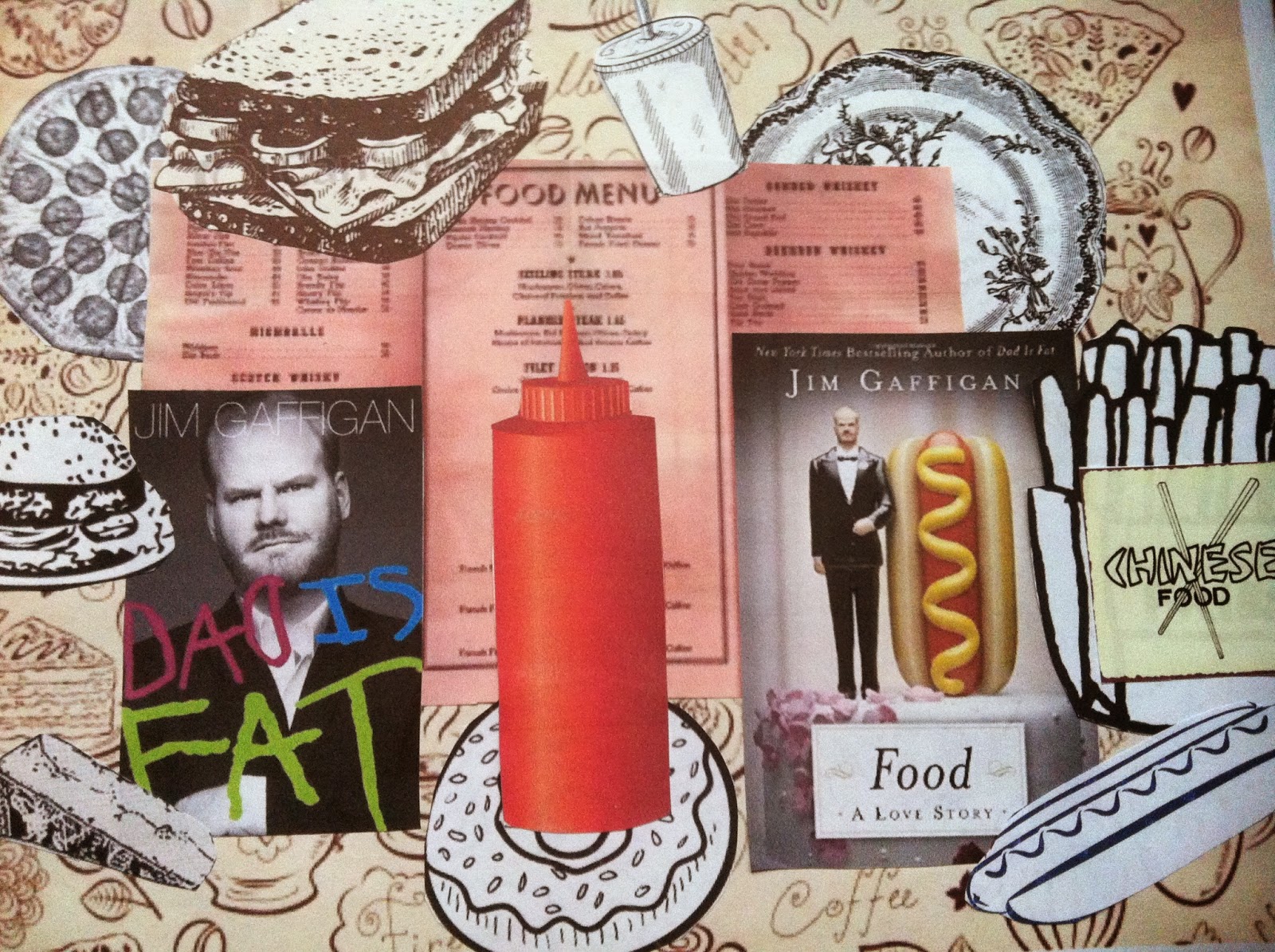
I've read these two really funny books recently. They were engrossing. They are about a person who is describes himself as fat. I'd like to recommend them to you now. Both of them are by Jim Gaffigan.

I saw Dad is Fat reviewed in a parenting magazine and immediately put it on hold at the library. What sold me on it - we'll not sold exactly, as I borrowed it  - was the part of the review that described Jim and his wife Jeannie raising five children in a two-bedroom apartment in NYC.

My husband and I are raising two children in a two-bedroom apartment in NYC. I have a friend who lives in a palatial home. Inexplicably, the enormous residence is in Manhattan. She has introduced me to other friends of hers at parties as the friend I told you about who lives in the tiny apartment.

So Jim and Jeannie were my heroes even before I picked up the book. There's an entire section in there about how they put their five kids to bed in the two-bedroom apartment. There are diagrams. There are strategies. They roll out this bedtime. It's a genius bedtime.

This was my favorite part of the book. But it was full of stuff about raising kids in NYC. I loved the rest of it. The only problem is that I like to do a lot of my reading on the subway. The book frequently had me in hysterics which causes a bit of a social issue if it's rush hour. So I'd put it away and read it at home. Jeremy would ask me what was so funny then I'd read it aloud to him.

I don't want to give you a blow by blow account. If you like funny books and are sick of all of this depressing crap out there, then read Dad is Fat.

I am an absolute pro at utilizing the New York Public library system.  When Jim Gaffigan's next book, Food: A Love Story came out I naturally put that one on hold right away.

The thing I love most about this book is that it's all about food and eating but isn't all high minded and sophisticated. The writer isn't traveling through parts of France you've never heard of, name dropping a bunch of famous intellectuals and rhapsodizing over some escargot he ate 35 years ago, and then going on about the after dinner aperitif.  It is not written in 1926. Gertrude Stein is not in it. It is not boring.

Jim Gaffigan lives in NYC. The book is a real page turner. I'd like to say I couldn't put it down. But the truth is, there were some specific times where I had to put it down.

There is the aforementioned laughter in public. I've been frank with you so far. Sometimes when I get going, I snort when I laugh. I'm not proud of it. So I cannot justify reading Jim Gaffigan's work on the subway anymore.

Remember how I said that I'm working to stay at a healthy weight? Sometimes while reading this book, I'd get really, really hungry and I'd have to put the damn thing down and go eat some food. This phenomenon was particularly striking while reading about meals Gaffigan and his family consumed at Katz's delicatessen. My God. The sandwiches.

The worst part was when I'd be reading the book before bed and it would make me hungry after I already brushed my teeth.

I hate it when I read a book review and I can tell that the reviewer did not read the entire book. I'm going to come clean. There was one part of the book I skipped over. That part of the book was about Poutine.

I had first heard about Poutine several years ago from extended family members who traveled to Canada. While in Canada, they discovered Poutine. When they came back from Canada, they described Poutine. They showed me photographs of Poutine. They were able to do this because they had a book about Poutine. They either purchased the Poutine book for themselves, or the book was a gift from people who knew how much they like Poutine.

At that point I said that I would never try Poutine. C'mon, people said. You have to try Poutine. But I don't want to try Poutine. I don't even want to read about Poutine. That's why I skipped the part of the book about Poutine.

In every good book there is a sense of mystery or the unexplained. And so it is with Food: A Love Story.

I love books with pictures. This book has quite a few. While reading the book, Jim Gaffigan referred to himself as fat. Indeed, he is not skinny.

But as I read about the eating this guy does and lived vicariously through him, I'd find myself flipping through the book to look at the pictures of Jim Gaffigan. The typical scenario might be him describing an all you can eat buffet, his behavior there and then me looking at his pictures.

Here is what I concluded. Although Gaffigan is not thin, he is not that fat. Quite frankly, with everything he's eating, he should be much fatter. I’m no doctor. But he seems to be doing pretty well for himself.

Even more confounding are the pictures of his wife Jeannie. I won't beat around the bush. The woman is gorgeous. She's had five kids and has the figure of a fashion model. She lives with Jim Gaffigan, yet she isn't even a little bit fat. If I lived with Jim Gaffigan instead of Jeremy Shatan, I would weigh more than Jim Gaffigan and Jeremy Shatan combined.


I might hate Jeannie Gaffigan except for the fact that she seems really nice in the book and took great care of her five children in the two-bedroom. I understand that they live in a larger place now, and I in no way hold this against them. She also commutes all over the city to bring her kids to schools out of their neighborhood and I love her for that too.